

The Behaviour We Notice Is Rarely The Problem
Why performance lives within an ecosystem, and why better questions lead to better interventions.
Fixing or understanding? Why behaviour points to deeper issues
Over the past few weeks, I’ve found myself having remarkably similar conversations with different organisations. Leadership development, coaching, away days, engagement surveys, collaboration – on the surface, the issues seem completely distinct. But underneath, a familiar pattern runs through them all: we’re getting better and better at proposing solutions before we’ve taken the time to understand the problem.
A common request is for assessments or quick fixes. I get it – when things aren’t working, action feels necessary. But I’ve learned to slow things down, peel back assumptions, and dig beneath the immediately visible behaviours. The conversation always becomes more valuable when we start asking not just about what people are doing, but why. The behaviour we notice is rarely the actual problem. More often, it’s a clue: a signpost pointing towards a set of conditions, pressures, or systemic issues that are causing those behaviours to emerge.
Moving beyond the individual: performance as part of the ecosystem
One concept that’s come to define my approach is this: performance doesn’t live inside individuals, it lives within an ecosystem. It’s tempting to pin responsibility on one person or a single team, but that’s rarely where the story ends. When I coach a leader or work with a team, it’s never just about fixing an individual. Instead, it’s about understanding the environment in which their behaviour is arising.
Let’s take a concrete example. A senior leader struggling under the weight of a new board role was exhibiting worrying behaviours. The easy explanation was to assume something personal, some shortcoming in character. But the real issue turned out to be a lack of clarity: no-one had helped him understand what success should look like in his new post. He filled in the gaps himself, set impossible standards and pressures, and this internal turbulence played out externally. Once we understood this, the intervention changed entirely: the focus shifted from ‘fixing’ him to clarifying expectations, redefining support, and aligning on what board-level success could mean.
The Better Work Framework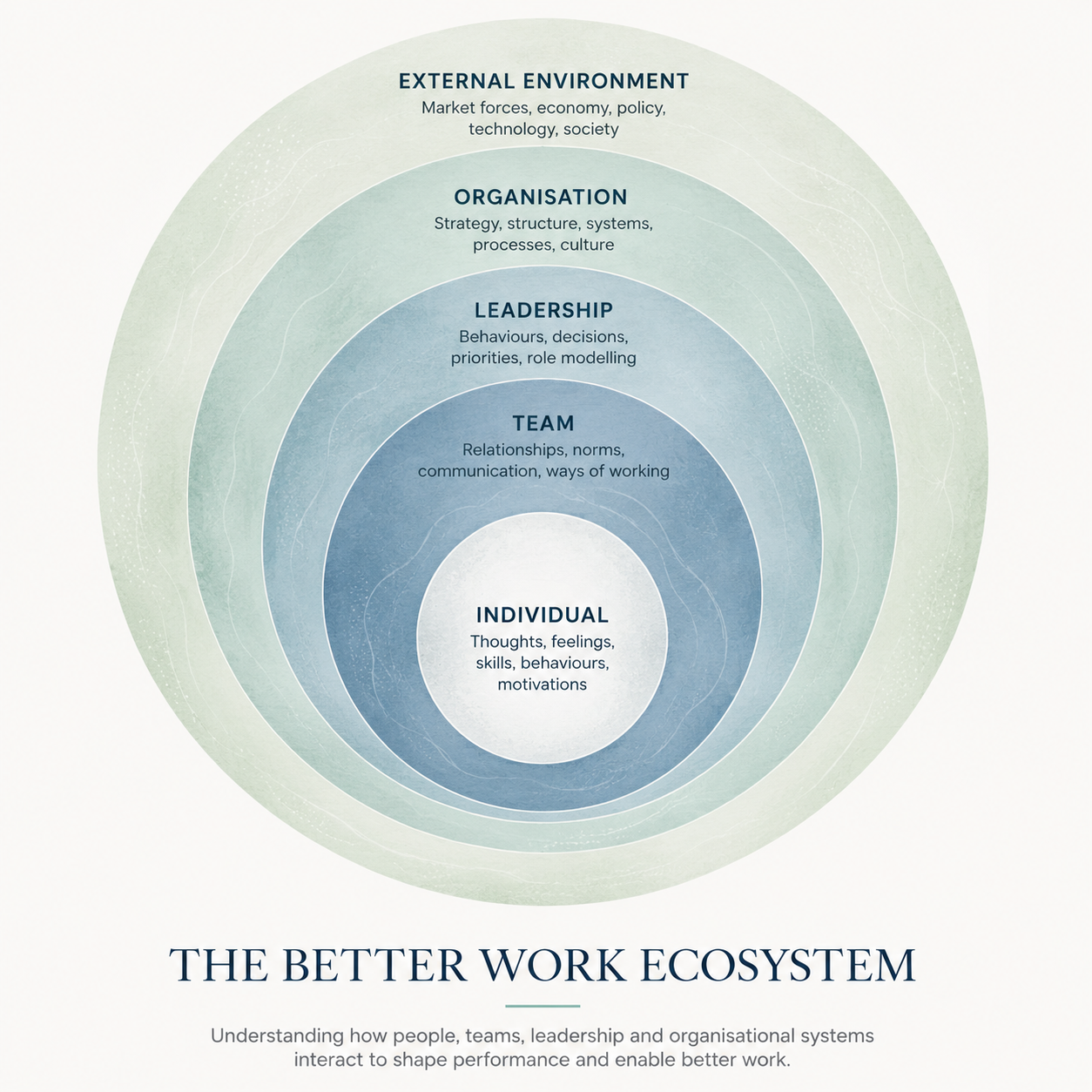
This is the simplest way I know to explain how I think about organisational performance.We often focus on individuals. But individual behaviour is shaped by teams. Teams are shaped by leadership.Leadership operates within organisational systems. And organisations themselves are influenced by wider external pressures. Understanding those interactions is what I call the Better Work Ecosystem.Think of the ecosystem as the map. It helps us see the whole picture. The Better Work Framework is how I navigate that map, making sense of what’s really going on before deciding what needs to happen next. Sometimes an assessment becomes part of that journey. Sometimes it doesn’t. The Better Work Framework doesn’t replace assessments. It helps determine whether they’re the right place to start, and how to interpret what they reveal alongside everything else happening in the organisation.
Widening the Lens
The Better Work Framework. It’s not a step-by-step process, nor is it yet another tool for the toolkit. It’s a mindset, a way of unpicking the situation before choosing your next move. The framework looks at five interconnected areas:
- The individual
- The team
- Leadership
- The organisation
- The wider environment
Each one influences the others. Sometimes the answer sits where we expected. Often it doesn’t. It’s only when all five interact that you can see the true contours of a challenge. The intervention only makes sense once you’ve considered the whole ecosystem.
Better questions, better outcomes
A key theme that emerged is simply this: the quality of our interventions is only as good as the quality of our diagnosis. Assessments, coaching, team days, management training – any one of these may turn out to be useful. But not until you’ve answered a few foundational questions:
- What are we actually trying to achieve?
- What’s making that difficult?
- What evidence or clues do we already have?
- What might we be overlooking?
This isn’t about seeking someone to blame or rushing towards a pre-packaged solution. It’s about building a culture where curiosity comes before certainty, and where both leaders and organisations take responsibility for creating conditions where people can truly thrive.
Before asking, “What intervention do we need?”perhaps pause and ask, “What are we really trying to understand?”
Because once we’re clear about that, the right intervention often becomes much easier to see.
If you’d like support to get under the surface of what’s really happening in your organisation, let’s connect.
Listen to this episode of Beyond the Water Cooler to hear me talk about practical ways to get under the surface of those recurring challenges.

